Written by: Anand Sen; Reviewed by: Dr R Arun
If you search “most popular cat breeds” on Instagram today, you’ll fall into a rabbit hole of irresistibly cute faces.
“Teacup Persian cross.”
“Doll-face hybrid.”
“Exotic mix kitten.”
The kittens? Adorable. The captions? Convincing. But the truth? Rarely mentioned.
Because behind most of these online listings lies a reality first-time pet owners never hear:
A kitten that looks similar to a fluffy cloud may carry a genetic blueprint for long-term health issues.
According to an article published in Frontiers in Veterinary Science, India’s cat population has crossed 9 million, and is continuously growing in cities like Mumbai and Bengaluru. With that rise, cat cross breeding in India, especially Persian-based crosses, has exploded.
But here’s the catch first-time cat parents must know:
The gap between responsible cross breeding and backyard breeding in India is massive.
And the consequences? They don’t show up on day one.
They show up at:
- 3 months, as breathing difficulties
- 1 year, as kidney disease
- 5 years, as a chronic illness
Feline veterinarians on Conbun, almost always see one common pattern. No health screening before breeding. This guide exists to change that.
It’ll break down:
- What cat cross breeding really means
- Whether hybrid vigour works in cats
- India’s most common crosses and their risks
- And how to identify a responsible breeder
Because the goal isn’t to scare you away from cross breed cats. It’s to help you choose wisely.
What Is Cat Cross Breeding - And How Is It Different From a Mixed Breed Cat?
Cat cross breeding is the intentional mating of two recognised purebred cats to produce kittens with desirable traits from both parents. It is similar to cross breeding in dogs and is done with an aim to combine specific traits like temperament, appearance or improved health.
In India, three terms related to cat cross breeding are mixed up constantly.
The 3 Categories Explained
| Type | Definition | India Example |
| Cross breed / Hybrid | Intentional mating of two purebreds | Persian × Himalayan or Siamese × Bengal |
| Mixed breed / Desi cat | Unknown multi-breed ancestry | Most are rescued Indian stray cats |
| Designer breed | Marketed cross with a fancy name | Teacup Persian cross |
The India Reality
In India, most “Persian cross” kittens sold are not carefully planned hybrids. They are not crossed with a second recognised pedigree breed, but are often:
Persian × local stray cat pairings
They are marketed as hybrid cats and are sold at premium prices. This is a backyard breeding practice that ignores ethical breeding, genetic planning and health screening for quick money.
Regulatory Insight
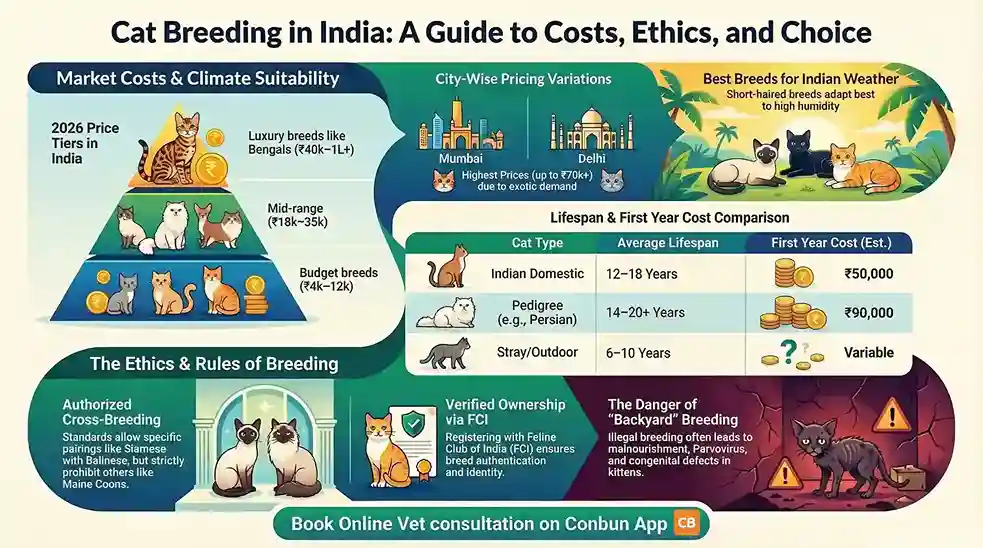
Neither The International Cat Association nor the Indian registries, such as the Feline Club of India. recognise cross breeds as formal cat breeds.
So, if a seller claims that a kitten is a “Registered hybrid breed” but refuses to show health certificates,
That’s a red flag.
Does Hybrid Vigour Apply to Cats? The Science Indian Buyers Need
When Hybrid Vigour Works
According to an article published in the Journal of Experimental Botany, hybrid vigour or heterosis is a phenomenon that describes the survival and performance superiority of a hybrid offspring over the average of both its genetically distinct parents.
It means that increased genetic diversity reduces inherited disease risk. Hybrid vigour applies to cats, but only under strict conditions.
Hybridisation is also supported by the World Small Animal Veterinary Association (WSAVA) breeding guidelines as it prioritises “health-focussed breeding” over strict breed purity to improve the welfare of the offspring.
Polycystic Kidney Disease is a common disease affecting 6% of the world’s feline population. A PKD-negative result indicates the absence of the genetic mutation causing this disease, meaning that the cat does not have the inherited form of this disorder.
So, as per Hybrid vigour:
If a PKD-negative Persian is crossed with a healthy Indie, there would be a lower probability of kidney disease.
Why It Fails in India
Here’s the uncomfortable truth:
- PKD testing or other health tests are rarely done
- Cardiac screening for Hypertrophic Cardiomyopathy, as echocardiography is unavailable at most breeding operations in India
- Breeding is unregulated
So instead of reducing risk cross breeding combines it.
Expert Insight
The belief that Persian crosses are the healthiest and most damaging myths in India’s cat market.
The Non-Negotiable Rule
Before buying a Persian, Himalayan or other recognised breed cross:
Ask for the PKD test certificates for both parents
If there’s no certificate, don’t purchase.
Most Popular Cross Breed Cats in India and Their Health Profiles
India’s crossbreed market is dominated by Persian-based mixes. This could be due to the long-standing popularity of Persian cats in India. However, these popular breeds have specific health risk profiles. Therefore, you must understand cat diseases & symptoms before going for a crossbreed.
Common Crosses and Risks
| Cross Breed | Parent Breeds | Key Risks | Climate Suitability |
| Persian × Indie | Persian × Desi | PKD, breathing issues, brachycephalic anatomy and skin infections | Moderate, Breathing concerns due to heat |
| Persian × Himalayan | Persian × Himalayan | Severe PKD risk, respiratory issues | Challenging, Air conditioning mandatory |
| Bengal × Indie | Bengal × Desi | HCM, eye disorders, Progressive Retinal Atrophy from Bengal | Generally Robust |
| Siamese × Indie | Siamese × Desi | Dental, respiratory, and cross-eyed conditions | Generally good due to the Siamese and Indie climate adaptability |
| Maine Coon × Persian | Maine Coon × Persian | HCM (both breeds), Joint issues, Hip Dysplasia | Challenges due to a heavy coat |
| Exotic Shorthair Cross | Exotic × Desi | Severe breathing issues and PKD | Poor, Chronic respiratory conditions |
Critical India Warning
Flat-faced (brachycephalic) crosses struggle in Indian summers (35–45°C)
They often require:
- AC environment
- constant health monitoring
Clinical Reality
The most common conditions seen on Conbun:
- PKD suspicion in Persian crosses
- respiratory distress
- skin infections during monsoon
PKD is highly prevalent in Persians (about 36-49%), but a DNA test for this disease is rarely performed in India. Himalayan and Persian crosses require a DNA test for both parents.
Cross Breed vs Purebred Cat in India - An Honest Comparison
Neither a cross breed nor a purebred is better. The right choice depends on your budget, lifestyle, climate and how much health predictability and temperament matter to you.
In an Indian context, both these options carry real risks and advantages.
Comparison Snapshot
| Factor | Cross Breed Cat | Purebred Cat |
| Genetic health | Potentially better, ONLY IF parents are health-screened | Predictable, well-documented health conditions for each specific breed |
| Temperament predictability | A variable can lean toward either parent | Higher breed temperament established |
| Coat/appearance | Can vary across litter | Always consistent |
| Price (India 2026) | ₹3,000–₹30,000 typically | ₹15,000–₹1,50,000+ (breed dependent) |
| India's climate suitability | Indie crosses do significantly better than others | Depends on the parent, Desi/Indie best |
| Vet care complexity | May inherit health conditions from both breeds | Well-documented health profile |
| Health test availability | Rarely done by Indian sellers | Should be performed |
| Rescue/adoption availability | Abundant, India shelters full | Found rarely in shelters |
Strong Recommendation
If you are not inclined towards owning a specific pedigree: Adopt. Indian rescue shelters are full of resilient, healthy mixed-breed cats. They are free, low-maintenance and generally resilient, and by adopting a pet, you also provide a welfare benefit of rehoming.
How to Identify Responsible Cat Cross Breeding in India - Red Flags and Green Flags
The cat market in India is highly unregulated, and thus, identifying a responsible breeder should be the first step.
Green Flags - Responsible Breeding
- PKD DNA test certificates (mandatory for Persian crosses)
- HCM screening proof for high-risk breeds
- Both parent cats should be visible and healthy
- Kittens are over the age of 12 weeks before adoption (as per AAFP guidance)
- Vaccinated as per schedule
- Breeder clearly explains health risks
- Documented health guarantee
Red Flags - Backyard Breeding
- Teacup or mini marketing claims
- No PKD testing or health certificates
- Kittens separated from mother before 8 weeks
- Multiple breeds available simultaneously
- Very low price
- Instagram-only sellers
- Doorstep delivery without a visit
- One or both parents not visible
Buying a crossbreed cat is not about how cute it looks today. It’s about what health reality it carries tomorrow.
If you’re still unsure,consult a certified veterinarian on Conbun, a pet doctor app, to learn about considerations you must follow before buying a cross breed.
Caring for a Cross Breed Cat in India - What’s Different From Purebred Care
Cross breed cat care in India must be tailored to the combined health risks of both parent breeds, in addition to India’s climate, not just generic cat care advice.
Care Based on Parent Breed Mix
Persian or flat-faced crosses (most common in India):
- Air conditioning is non-negotiable, not optional (a health requirement for Brachycephalic cats)
- Daily face cleaning prevents skin fold dermatitis, which is a common skin condition in flat-faced breeds
- Constant health monitoring for breathing difficulties
- Early kidney screening (PKD risk) from the age of 2, even for negative cats
- Regular ear cleaning to prevent cat ear mites
Bengal or active breed crosses:
- High play needs, use vertical spaces or interactive pet toys like feeders for enrichment
- Prevent boredom-driven aggression
- Catnip can be used as a mental enrichment tool
- Annual cardiac check from age 3 to check HCM risk
Indie (Desi) crosses:
- Strong immunity, but high parasite exposure
- Monthly tick, flea and worm prevention is critical as they carry tick exposure history
India-Specific Non-Negotiables
- Pre-monsoon hygiene + skin checks
- Annual wellness exam aligned to breed risks
- Nutrition tailored to size + activity
A quick veterinary consultation online via a trusted pet care app helps personalise this plan, especially for first-time cat parents.
Real Conbun Case Spotlight
Delhi, Persian Cross Kitten, Age 3 Months
Meera bought “Biscuit,” a Persian-Exotic cross, from Instagram for just ₹12,000.
At 3 months:
- Noisy breathing
- Nasal discharge
- Low activity
She opted for an online pet care consultation where a certified vet on Conbun identified brachycephalic airway syndrome, which was later confirmed by clinical tests.
- Severely narrowed nasal passages
- Surgical correction required
What Went Wrong?
- Kitten was sold to Meera at 7 weeks (too early)
- No PKD testing was done
- No breeder transparency
Real Cost
₹12,000 (purchase)
₹45,000 (surgery within 3 months)
Lesson
One pre-purchase vet consultation could have changed everything.
FAQ - Cat Cross Breeding India
Q1: What is cat crossbreeding in India?
Answer. Intentional mating of two purebred cats to produce an offspring with desirable traits from both parents.
Q2: Are crossbreed cats healthier than purebred cats in India?
Answer. Only if both parents are healthy, a crossbreed will be healthy. Otherwise, the risk remains high.
Q3: What health problems do Persian crossbreed cats get in India?
Answer. Breathing issues, skin fold infections, ear mites, dental problems and PKD are common Persian cross-breed health problems.
Q4: What is PKD in Persian cats, and should I test for it?
Answer. Polycystic Kidney Disease is a genetic kidney disease common in Persian cats and always requires DNA testing before buying.
Q5: What is the price of a crossbreed cat in India in 2026?
Answer. The price of a crossbreed ranges from ₹5,000 to ₹40,000 depending on the seller and perceived pedigree.
Q6: Is it better to adopt a crossbreed cat or buy one in India?
Answer. Adoption is considered to be ethical. In addition, it is affordable and also provides the benefit of rehoming to cats.
Q7: Are flat-faced cross breed cats suitable for India?
Answer. They are suitable but require constant health monitoring and require AC in heat.
Q8: Can I book an online vet for cross breed cat health advice in India?
Answer. Yes, via pet doctor apps like Conbun offering veterinary consultation online.
Conclusion
Cat cross breeding in India sits at a delicate interaction between potential and risk.
A well-bred cross can be:
- resilient
- adaptable
- deeply suited to Indian homes
But an irresponsibly bred one? Can carry lifelong health challenges that no amount of love can undo.
The difference lies in three simple steps:
- Understand the breed mix
- Verify PKD and HCM screening
- Seek expert advice before you commit
And today, where expert advice is more accessible than ever through online pet care consultation, a reliable pet care app can inform you from day one.
Because the smartest cat parents don’t just fall in love with a kitten. They understand it first.
Author Bio: Anand Sen is an experienced content writer who, with a strong focus on pet health and preventive care, creates trustworthy, clear content. With an experience of more than 8 years in the content industry, he now works closely with veterinary professionals on the Conbun to translate clinical pet care insights and evidence-based guidance into practical advice so that pet parents can make informed decisions and care for their pets responsibly